
Fennec Fox
The fennec fox lives in the Sahara Desert and uses its enormous ears — which can be half the length of its body — to hear insects moving underground and to release body heat in the scorching sun.
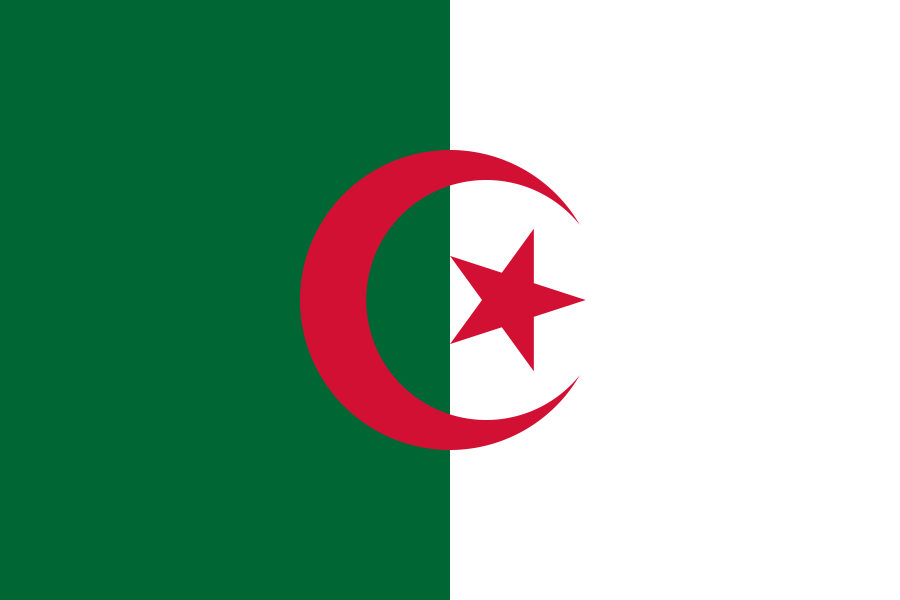
Flag of Algeria
Field Report
Algeria sits on the northern edge of Africa, tucked between the Mediterranean Sea and the vast Sahara Desert, with Morocco to its west and Tunisia to its east. It is the biggest country on the entire African continent, home to about 45 million people who speak Arabic and Tamazight and whose ancestors include ancient Berber civilizations, Roman settlers, and Arab traders. Most people in Algeria follow Islam, which means very few have yet had the chance to hear and believe the good news about Jesus.
From the Field Notebook
Fennec Fox
The fennec fox lives in the Sahara Desert and uses its enormous ears — which can be half the length of its body — to hear insects moving underground and to release body heat in the scorching sun.
Barbary Macaque
The Barbary macaque is the only wild monkey found in Africa north of the Sahara, living in the cedar and oak forests of Algeria's rugged mountain regions.
Dorcas Gazelle
The dorcas gazelle is a small, graceful antelope perfectly built for desert life, able to go its entire life without ever drinking standing water because it draws moisture from the plants it eats.
Couscous
Couscous is tiny steamed grains of semolina wheat served under a rich stew of lamb, vegetables, and warm spices like cinnamon and cumin, and it is so central to Algerian life that families often gather around a shared dish of it on Fridays.
Merguez
Merguez is a slender, deep-red spiced sausage made from lamb or beef and flavored with harissa chili paste, often grilled over charcoal and eaten tucked inside fresh bread at markets and family gatherings.
Msemen
Msemen is a square, flaky flatbread folded many times and cooked on a dry griddle until golden, commonly eaten at breakfast with honey and butter alongside a glass of sweet mint tea.
Algeria is the largest country in Africa and the tenth-largest in the entire world, yet roughly 90 percent of its people live along the thin northern strip of coastline because the rest is Sahara Desert.
The Sahara Desert covers more than four-fifths of Algeria's land, and inside that desert sit the Hoggar Mountains, where ancient volcanic peaks rise nearly three kilometers into the sky.
Algeria has ruins from the Roman Empire still standing on its soil, including the ancient city of Timgad, which was buried under sand for centuries and is so well-preserved that its grid of streets looks like a city frozen in time.
The Tuareg people of southern Algeria have used a writing system called Tifinagh for thousands of years — making it one of the oldest alphabets still in use anywhere on earth.
Algeria produces a significant share of the world's natural gas, and pipelines run under the Mediterranean Sea all the way to Europe, meaning a family heating their home in Italy or Spain may be using energy that came from Algerian ground.
Daily Life
76
Years life expectancy
75%
Can read and write
98%
Kids go to school
Missions Field Report
Algeria is home to 37 distinct people groups — 35 of them haven’t yet heard about Jesus.
Nearly all Algeria's people follow Islam (99.3%). Less than 1% of people in Algeria are Evangelical Christians.
What People Believe
Unreached People Groups
These are communities of people who haven’t had the chance to hear about Jesus yet. They need missionaries — and they need kids like you to pray for them.
Algerian, Arabic-speaking
34,426,000 people
Berber, Kabyle
6,729,000 people
Berber, Shawiya
2,489,000 people
Berber, Tamazight
1,781,000 people
Deaf
240,000 people
Prayer Journal
Tick each one as you pray. God hears every word.