
Western Lowland Gorilla
The dense rainforests of Equatorial Guinea are home to western lowland gorillas, which are the largest primates on earth and can travel miles each day foraging for fruit and leaves.
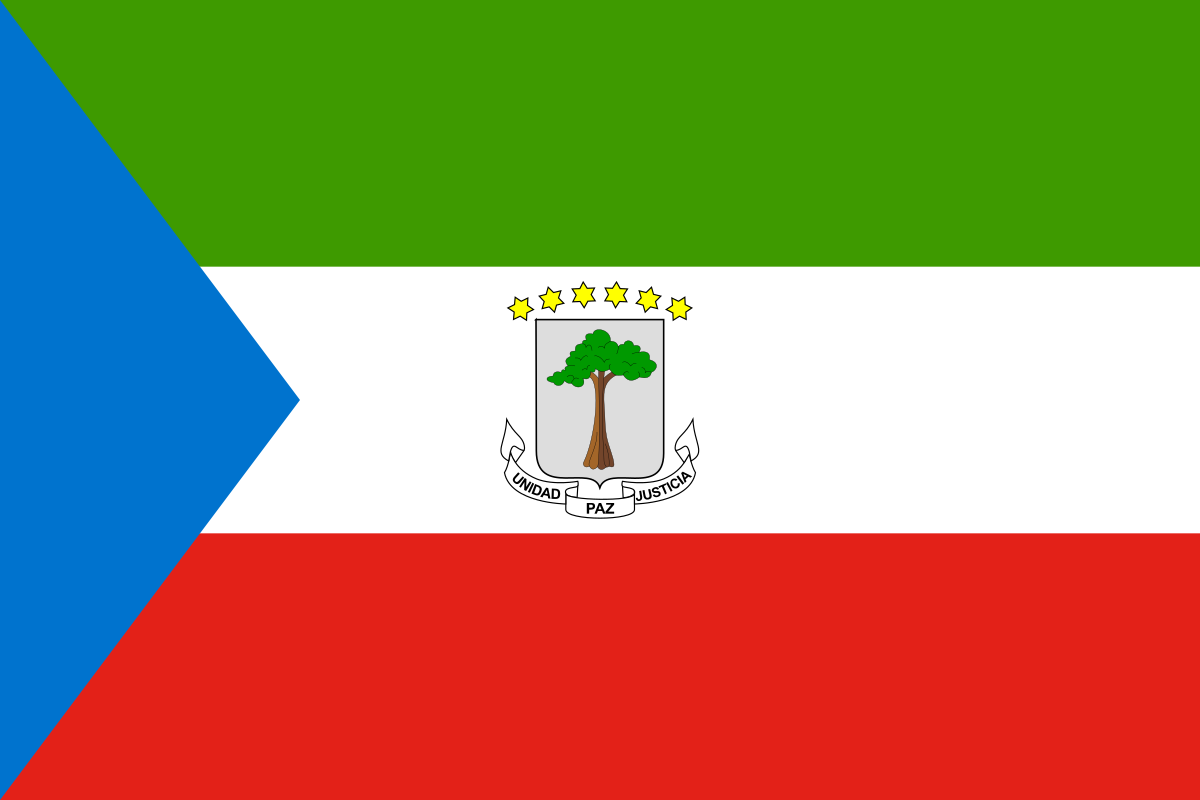
Flag of Equatorial Guinea
Field Report
Equatorial Guinea is a tiny country on the west coast of Africa, so small that most world maps barely show its name, yet it packs in jungle-covered mountains, a volcanic island, and more than a dozen different people groups speaking different languages. It sits right on the equator, which means the air is warm and heavy with rain nearly all year long, and the forests grow thick and loud with wildlife. Most people outside Africa have never heard of it, but God knows every person who lives there, and He is at work.
From the Field Notebook
Western Lowland Gorilla
The dense rainforests of Equatorial Guinea are home to western lowland gorillas, which are the largest primates on earth and can travel miles each day foraging for fruit and leaves.
African Forest Elephant
Smaller and shaggier than their savanna cousins, African forest elephants push through the jungle undergrowth of Bioko Island and the mainland region called Río Muni.
Drill Monkey
The drill is a striking, colorful monkey found in the forests of Equatorial Guinea whose bright red, blue, and purple face markings make it one of the most vividly colored mammals in Africa.
Sopa de Pescado
A thick, warming fish soup made with plantains and palm oil that families in coastal villages often share from a single large pot.
Fufu
A dense, doughy staple made from pounded cassava or plantain that is torn off in small pieces and used to scoop up stews and sauces at nearly every meal.
Pepper Soup
A boldly spiced broth built from local chilies, leafy greens, and whatever meat or fish is available, with a heat that builds slowly as you eat.
Equatorial Guinea is the only country in all of Africa where Spanish is an official language, a leftover from more than a century of Spanish colonial rule.
The country is split into two separate pieces that do not touch each other — a small island called Bioko sitting in the Atlantic Ocean, and a patch of mainland jungle bordered by Cameroon and Gabon.
Equatorial Guinea sits almost exactly on the equator, which means it gets roughly twelve hours of daylight and twelve hours of darkness every single day of the year, no matter the season.
When oil was discovered offshore in the 1990s, Equatorial Guinea went from being one of Africa's poorest countries to having one of the highest per-capita incomes on the continent almost overnight.
The Fang people, who make up the largest ethnic group, have a tradition of intricate wooden masks and carved ancestor figures that are considered some of the finest sculpture in all of African art history.
Daily Life
64
Years life expectancy
88%
Can read and write
43%
Kids go to school
Missions Field Report
Equatorial Guinea is home to 16 distinct people groups — 1 of them haven’t yet heard about Jesus.
Most Equatorial Guinea's people follow Christianity (89.4%). Evangelical Christians make up about 4.8% of the population.
What People Believe
Unreached People Groups
These are communities of people who haven’t had the chance to hear about Jesus yet. They need missionaries — and they need kids like you to pray for them.
Hausa
39,000 people
Prayer Journal
Tick each one as you pray. God hears every word.