
Griffon Vulture
This large soaring bird, with a wingspan that can reach nearly nine feet, rides the warm air currents rising off Montenegro's dramatic limestone cliffs along the Adriatic coast.
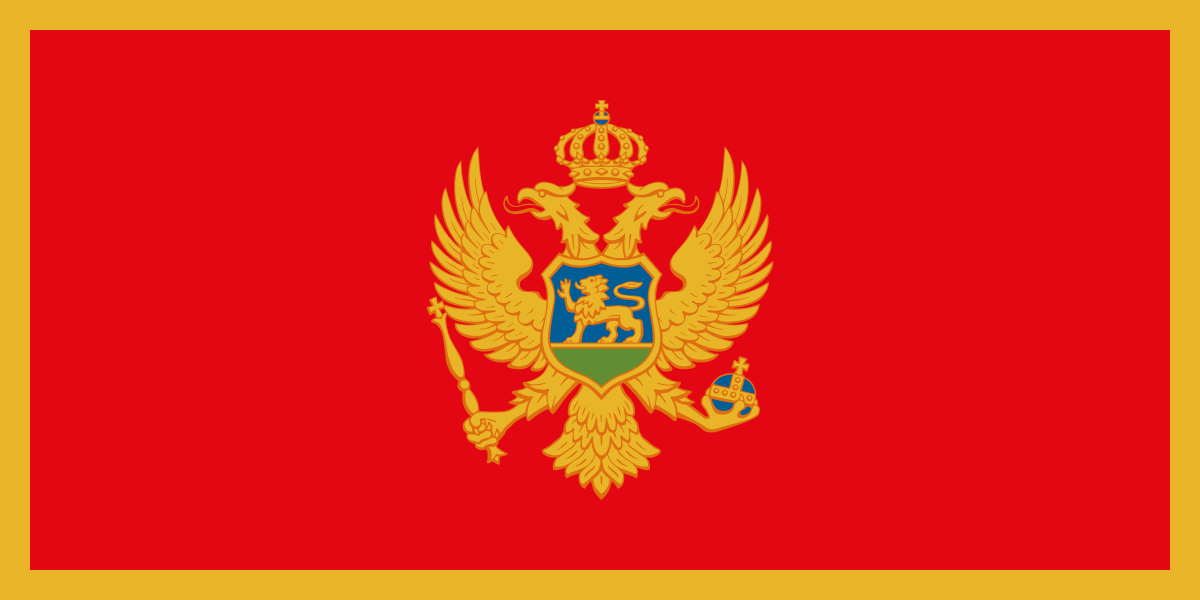
Flag of Montenegro
Field Report
Montenegro is a tiny country about the size of a large county, tucked between the Adriatic Sea and the rugged mountains of southeastern Europe — a region often called the Balkans. It has tall peaks, deep canyons, and a short but beautiful coastline, all packed into a space so small you could drive across it in a few hours. Most people there follow Orthodox Christianity as a cultural tradition, but relatively few have a personal relationship with Jesus, which is why it is an important place for Christians around the world to pray for.
From the Field Notebook
Griffon Vulture
This large soaring bird, with a wingspan that can reach nearly nine feet, rides the warm air currents rising off Montenegro's dramatic limestone cliffs along the Adriatic coast.
European Brown Bear
Brown bears still roam the dense mountain forests of Montenegro's north, making this small country one of the few places in Europe where they survive in the wild.
Adriatic Sturgeon
This ancient fish, which has existed since the time of the dinosaurs, once filled the rivers feeding into the Adriatic Sea near Montenegro's coast, though it is now rarely seen.
Kacamak
A thick, hearty porridge made from cornmeal and mixed with potato, butter, and sometimes cheese, this humble mountain dish has kept Montenegrin families warm through cold winters for generations.
Njeguški Pršut
This dry-cured ham from the village of Njeguši is salted, smoked over beech wood, and aged in mountain air, giving it a rich, deep flavor that locals consider a point of national pride.
Priganice
These small, soft fried dough puffs are often served at breakfast with honey or cheese and are the kind of simple, satisfying food that Montenegrin grandmothers have made for their families for as long as anyone can remember.
Montenegro is so small that the entire country covers less land than the state of Connecticut, yet it contains both a long Adriatic coastline and some of the highest mountain peaks in the Balkans.
The name Montenegro comes from Venetian Italian and means 'Black Mountain,' named for the dark, forested appearance of Mount Lovćen when seen from the sea.
The Tara River Canyon in northern Montenegro is the deepest river canyon in Europe, dropping more than 4,000 feet from its rim to the river below — deeper than many parts of the Grand Canyon.
Montenegro declared independence in 2006 after a referendum, making it one of the newest countries in the world, even though people have lived in this region for thousands of years.
Lake Skadar, which Montenegro shares with neighboring Albania, is the largest lake in the entire Balkan Peninsula and sits in a wide, shallow basin that was once an ancient inland sea.
Daily Life
78
Years life expectancy
99%
Can read and write
97%
Kids go to school
Missions Field Report
Montenegro is home to 12 distinct people groups — 3 of them haven’t yet heard about Jesus.
A majority of Montenegro's people follow Christianity (73.9%). Less than 1% of people in Montenegro are Evangelical Christians.
What People Believe
Unreached People Groups
These are communities of people who haven’t had the chance to hear about Jesus yet. They need missionaries — and they need kids like you to pray for them.
Bosniak
54,000 people
Egyptian, Balkan
2,000 people
Deaf
2,000 people
Prayer Journal
Tick each one as you pray. God hears every word.