
Coconut Crab
The largest land-living arthropod on Earth, this powerful crab can crack open a coconut with its claws and is found on the remote islands of the Marshall Islands.
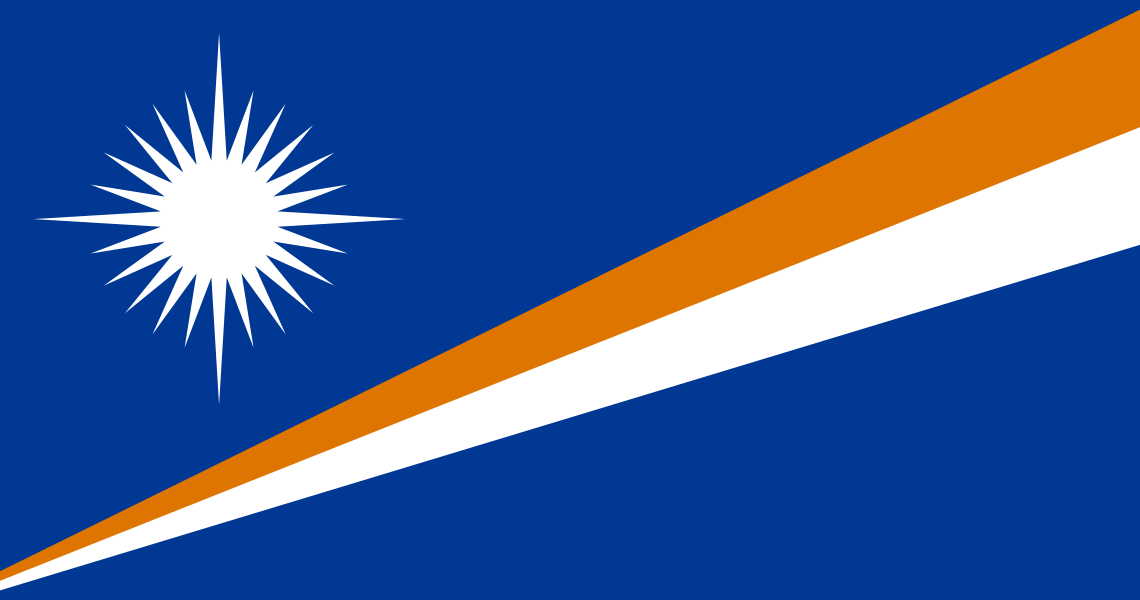
Flag of Marshall Islands
Field Report
The Marshall Islands is a small Pacific island nation tucked between Hawaii and the Philippines, made up of dozens of tiny coral atolls — ring-shaped islands sitting just barely above the surface of a vast, deep ocean. About 42,000 people live there, speaking their own language called Marshallese and depending on the sea and the coconut palm for much of daily life. Though the islands are far from most of the world, God knows every person there by name, and Christians around the world are praying that many more Marshallese people would come to know Jesus.
From the Field Notebook
Coconut Crab
The largest land-living arthropod on Earth, this powerful crab can crack open a coconut with its claws and is found on the remote islands of the Marshall Islands.
Green Sea Turtle
These ancient reptiles glide through the warm lagoons of the Marshall Islands, returning to the same sandy beaches where they were born to lay their eggs.
Blacktip Reef Shark
A slender, fast-moving shark recognized by the black tips on its fins, it patrols the shallow coral reefs that ring nearly every Marshallese atoll.
Breadfruit
A starchy, round fruit that can be roasted, boiled, or pounded into a soft paste, breadfruit has been a filling staple for Marshallese families for generations.
Coconut Rice
Plain rice cooked in rich coconut milk until it is soft and slightly sweet, this everyday dish shows how deeply the coconut palm feeds nearly every part of island life.
Pounded Taro
Taro root is boiled and then pounded into a thick, grayish paste with a mild, earthy flavor that Marshallese people have eaten as a traditional food for centuries.
The Marshall Islands is made up of 29 low-lying coral atolls and 5 single islands scattered across an area of ocean roughly the size of Mexico, yet all the land combined is smaller than Washington D.C.
The highest point in the entire country is only about 10 meters above sea level, making it one of the flattest nations on Earth.
Between 1946 and 1958, the United States tested 67 nuclear weapons in the Marshall Islands — most at Bikini and Enewetak atolls — leaving some islands still uninhabitable today.
Marshallese navigators historically used remarkable stick charts — frames of curved sticks and shells — to memorize ocean wave patterns and sail hundreds of miles between islands without any modern instruments.
The Marshall Islands is one of only a handful of countries in the world where the leader of the nation is directly elected by the parliament rather than by a nationwide popular vote.
Daily Life
67
Years life expectancy
96%
Can read and write
73%
Kids go to school
Missions Field Report
Marshall Islands is home to 6 distinct people groups — 2 of them haven’t yet heard about Jesus.
Most Marshall Islands's people follow Christianity (94.6%). Evangelical Christians make up about 53.4% of the population.
What People Believe
Unreached People Groups
These are communities of people who haven’t had the chance to hear about Jesus yet. They need missionaries — and they need kids like you to pray for them.
Japanese
300 people
Deaf
200 people
Prayer Journal
Tick each one as you pray. God hears every word.