
Turquoise-browed Motmot
Nicaragua's national bird has a striking turquoise-and-rufous plumage and a distinctive racket-tipped tail it swings like a pendulum when perched.
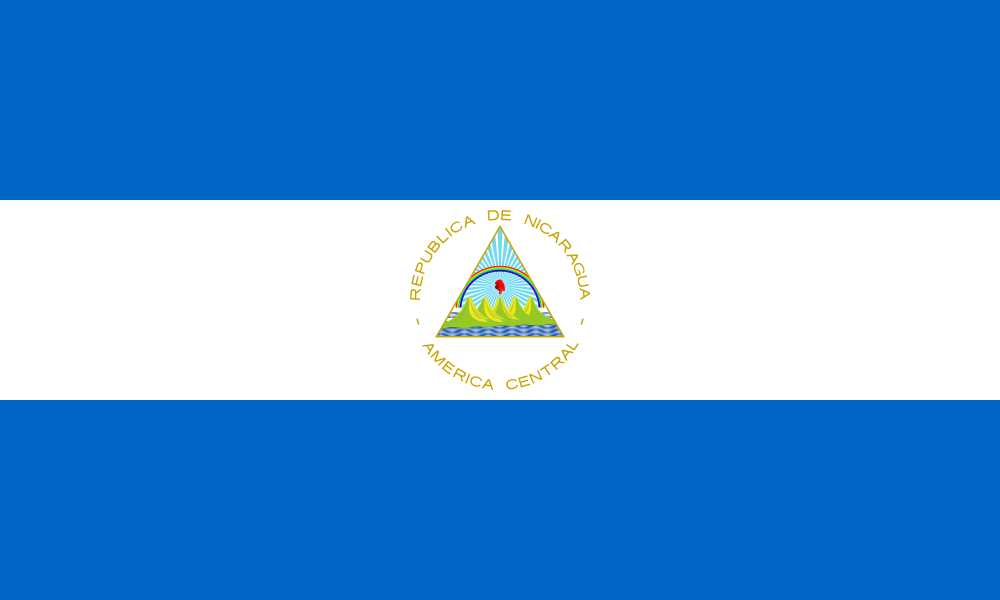
Flag of Nicaragua
Field Report
Nicaragua sits in the middle of Central America, tucked between Honduras to the north and Costa Rica to the south, with the Pacific Ocean on one side and the Caribbean Sea on the other. It is a land of volcanoes, wide lakes, and dense forests, and most of its people live in cities and farming towns along the Pacific side of the country. More than six million people call Nicaragua home, and the vast majority of them speak Spanish as their everyday language.
From the Field Notebook
Turquoise-browed Motmot
Nicaragua's national bird has a striking turquoise-and-rufous plumage and a distinctive racket-tipped tail it swings like a pendulum when perched.
Jaguar
The largest wild cat in the Americas still roams Nicaragua's remote forests and is known for its extraordinary ability to swim across wide rivers.
Leatherback Sea Turtle
The world's largest turtle, weighing up to 2,000 pounds, nests on Nicaragua's Pacific coast beaches and has existed in nearly the same form for over 100 million years.
Gallo Pinto
A hearty mixture of rice and red beans cooked together with onion and sweet peppers, eaten by most Nicaraguan families at breakfast nearly every single morning.
Vigorón
Boiled yuca topped with chicharrones and a tangy cabbage salad, all served on a banana leaf and sold at markets throughout the city of Granada.
Nacatamal
A large, dense tamale filled with seasoned pork, rice, and vegetables, wrapped in a plantain leaf and steamed for hours — it is the traditional Sunday-morning meal for many families.
Nicaragua is the largest country in Central America by land area, yet it has fewer people than many single cities in the United States.
Lake Nicaragua contains the only freshwater sharks in the world — bull sharks that learned to navigate between the lake and the ocean long ago.
Nicaragua has two coastlines: the Pacific Ocean on the west and the Caribbean Sea on the east, meaning you can reach two entirely different oceans within a single day of travel.
The country has a chain of volcanoes running along its Pacific side, and one of them — Masaya — has a lava lake inside its crater that has been glowing for hundreds of years.
Nicaragua's capital city, Managua, does not have a traditional downtown grid of streets because a catastrophic earthquake in 1972 destroyed the old city center and it was never fully rebuilt.
Daily Life
75
Years life expectancy
87%
Can read and write
100%
Kids go to school
Missions Field Report
Nicaragua is home to 16 distinct people groups — 1 of them haven’t yet heard about Jesus.
Nearly all Nicaragua's people follow Christianity (96.1%). Evangelical Christians make up about 43.3% of the population.
What People Believe
Unreached People Groups
These are communities of people who haven’t had the chance to hear about Jesus yet. They need missionaries — and they need kids like you to pray for them.
Deaf
6,200 people
Prayer Journal
Tick each one as you pray. God hears every word.