
Bird-of-Paradise
Male birds-of-paradise perform elaborate dances and display feathers of vivid color to attract mates, and Papua New Guinea is home to more than 38 of the world's 42 species.
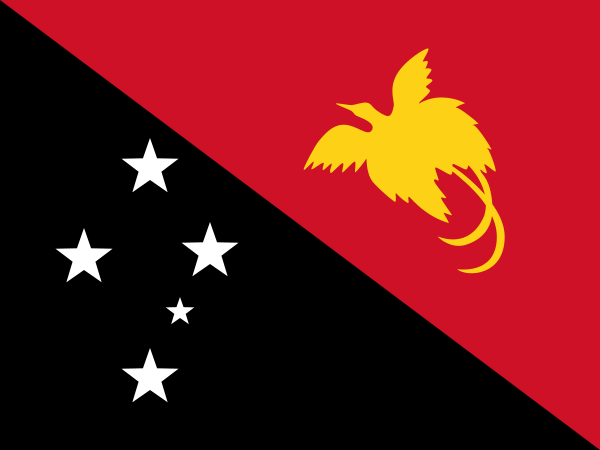
Flag of Papua New Guinea
Field Report
Papua New Guinea is a rugged, mountainous country in the southwestern Pacific Ocean, just north of Australia, covering the eastern half of the island of New Guinea along with hundreds of smaller islands. It is one of the most linguistically and culturally diverse places on earth, where hundreds of distinct peoples live in rainforest valleys and highland villages, many of them still following the traditions of their ancestors. Missionaries have been bringing the gospel there for over a century, yet hundreds of language groups are still waiting to hear about Jesus in their own tongue.
From the Field Notebook
Bird-of-Paradise
Male birds-of-paradise perform elaborate dances and display feathers of vivid color to attract mates, and Papua New Guinea is home to more than 38 of the world's 42 species.
Tree Kangaroo
Unlike their ground-dwelling cousins in Australia, tree kangaroos climb through the rainforest canopy using strong forelimbs and a long tail for balance.
Saltwater Crocodile
The saltwater crocodile is the largest living reptile on earth, and Papua New Guinea's rivers and coastal mangroves are among its most active habitats.
Mumu
Mumu is a traditional feast where sweet potato, taro, pork, and greens are wrapped in banana leaves and slow-cooked over hot stones in an earthen pit, filling the air with a deep, smoky sweetness.
Sago
Sago is a starchy staple made from the pith of the sago palm tree, and many lowland communities eat it daily as a thick porridge or flat cake.
Kaukau
Kaukau is the local name for sweet potato, which has been grown in the highlands for thousands of years and remains the most widely eaten food in the country.
Papua New Guinea has more than 800 distinct languages — that is roughly one-tenth of all the languages spoken anywhere on earth, packed into a single country.
The country sits on the Pacific Ring of Fire, meaning it experiences frequent earthquakes and is home to active volcanoes, including Tavurvur, which buried the nearby town of Rabaul in ash in 1994.
Papua New Guinea was one of the last places on earth to be explored by outsiders, and some highland communities had their first contact with the outside world as recently as the 1930s.
The island of New Guinea, which Papua New Guinea shares with Indonesia, is the second-largest island in the world, smaller only than Greenland.
Port Moresby, the capital city, is widely considered one of the most linguistically diverse capital cities on earth, where people from hundreds of different language groups live side by side.
Daily Life
66
Years life expectancy
87%
Can read and write
74%
Kids go to school
Missions Field Report
Papua New Guinea is home to 883 distinct people groups — 1 of them haven’t yet heard about Jesus.
Most Papua New Guinea's people follow Christianity (94.3%). Evangelical Christians make up about 23.4% of the population.
What People Believe
Unreached People Groups
These are communities of people who haven’t had the chance to hear about Jesus yet. They need missionaries — and they need kids like you to pray for them.
Deaf
30,000 people
Prayer Journal
Tick each one as you pray. God hears every word.